
How Team-Based Work Builds Trust on Your Team

Trust in teams is defined as a structural capability, not a feeling. It is built through predictable behavior, shared vulnerability, and repeated coordination. Understanding how team-based work builds trust means recognizing that every joint task, every shared deadline, and every moment of honest feedback is a deposit into a collective trust account. Research from Google’s Project Aristotle and frameworks from FranklinCovey confirm that trust is the single most reliable predictor of team performance. One-off retreats and icebreakers do not build it. Consistent, work-embedded interaction does.
How team-based work builds trust through psychological safety
Psychological safety is the collective belief that team members can take interpersonal risks without punishment or humiliation. It is not about being comfortable. It is about being willing to speak up, admit mistakes, and challenge ideas without fear of retaliation. Google’s Project Aristotle studied more than 180 teams and found psychological safety to be the top predictor of team effectiveness. That finding reframed how organizational development professionals think about performance. The issue was never talent or process. It was safety.
Team-based work creates psychological safety through repetition. When people work together on real tasks with real stakes, they accumulate shared experiences. Each time a team member raises a concern and is heard, the safety signal gets stronger. Each time a leader admits they do not have the answer, the permission to be imperfect spreads through the group. This is how collaboration fosters trust at the behavioral level.

Leaders play a decisive role here. A leader who models vulnerability by saying “I was wrong about that” gives the entire team permission to do the same. A leader who manages tension productively, without blame, teaches the team that conflict is safe. These are not soft skills. They are the operating conditions for high performance.
Key behaviors that build psychological safety in team-based work:
Asking questions instead of giving directives during problem-solving sessions
Naming mistakes publicly and focusing on learning rather than blame
Inviting dissent by explicitly asking “What am I missing?” in meetings
Responding to bad news with curiosity instead of frustration
Acknowledging contributions by name, not just by role
Pro Tip: Run a brief anonymous pulse check after team meetings. Ask one question: “Did you feel safe sharing your honest opinion today?” The pattern across weeks reveals your team’s actual safety level, not the one you assume.
Why consistent daily interactions sustain trust better than events
People forget up to 70% of new information within 24 hours without reinforcement. The same decay applies to trust signals. A team-building retreat in January means almost nothing by march if the daily work environment contradicts its lessons. This is the core problem with event-based trust programs. They feel good in the moment and fade fast.
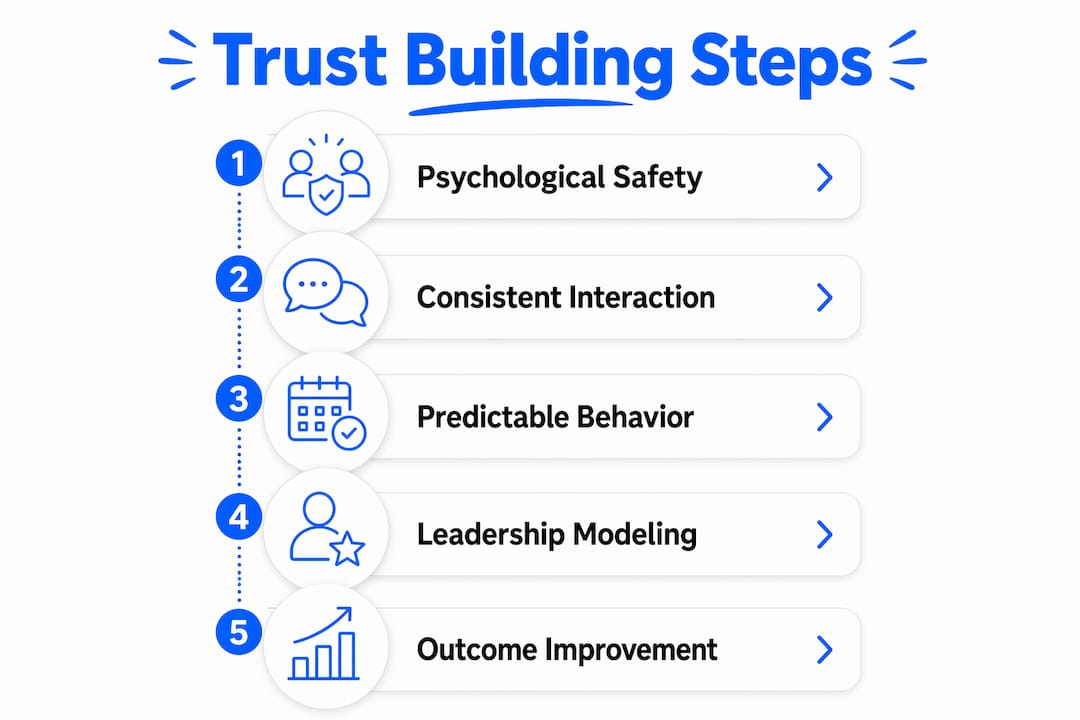
Trust compounds through repeated, work-embedded interactions. The mechanism is simple. Every time a colleague follows through on a commitment, trust increases. Every time a team member asks for help and receives it, trust increases. These micro-moments accumulate into a durable foundation. Enhancing trust in teams requires redesigning how work flows, not just how people socialize.
Four specific practices build trust through daily interaction:
Daily standups with visible ownership. When each person states what they are working on and what they need, contributions become visible and interdependence becomes real. This is not status reporting. It is shared fate made explicit.
Cross-functional pairing on deliverables. Assigning two people from different functions to co-own a task forces coordination and creates observable vulnerability. Both people must rely on each other.
Retrospectives focused on behavior, not output. A weekly or biweekly retrospective that asks “What did we do well as a team?” and “What got in our way?” builds the habit of honest reflection. Output reviews do not build trust. Behavior reviews do.
Transparent progress tracking. Using shared tools like Asana, Trello, or Monday.com makes work visible to everyone. Visibility reduces suspicion and increases accountability without surveillance.
Pro Tip: In hybrid teams, rotate who leads the standup each week. Rotating leadership distributes ownership and prevents the trust dynamic from centering on one person.
Trust-building method | Frequency | Trust impact |
One-off team retreat | Once or twice a year | Low, fades within weeks |
Weekly retrospective | Weekly | High, compounds over time |
Cross-functional pairing | Per project | High, creates real interdependence |
Shared progress tracking | Daily | Medium to high, reduces suspicion |
Shared fate and real coordination compound trust more than any social activity. The workflow is the trust-building program.
What leadership behaviors actually build trust in teams
Trust in teams does not emerge from personality. It emerges from predictable behavior. Predictability reduces social wariness and accelerates decision-making because people stop spending energy guessing what their leader will do next. A leader who is consistent, even when delivering hard news, builds more trust than a leader who is warm but unpredictable.
The distinction between controlling leadership and predictability-based leadership matters here. Controlling leaders create compliance. Predictability-based leaders create trust. The difference shows up in how they communicate expectations, handle failure, and explain decisions.
Four leadership behaviors that build trust through team-based work:
Explain the “why” behind decisions. Lack of contextual explanation leads people to fill the gap with negative assumptions. A leader who announces a process change without explaining the reason invites distrust. A leader who says “Here is why we are doing this, and here is what it means for you” closes that gap.
Frame accountability as care, not punishment. Holding someone accountable means caring enough about their success to name a gap and work through it together. Teams that experience accountability as punishment stop taking risks. Teams that experience it as support take more of them.
Give feedback in real time, not just in reviews. Annual performance reviews do not build trust. Consistent, specific, timely feedback does. It signals that the leader is paying attention and invested in the person’s growth.
Empower with clear boundaries. Empowerment without clarity creates anxiety, not confidence. A leader who says “You own this decision, and here are the constraints you are working within” gives the team both freedom and safety.
“Trust is built when leaders demonstrate integrity and consistency, actively listen, and give team members genuine ownership over their work.” — FranklinCovey
The importance of team-based work in leadership development cannot be overstated. Leaders who work alongside their teams, not just above them, build credibility through action. That credibility is the foundation of trust.
How trust improves team outcomes and organizational performance
Trust produces measurable performance gains. FranklinCovey describes these as trust dividends: faster decisions, less communication overhead, and higher execution speed. The inverse is equally measurable. Low-trust teams pay trust taxes in the form of redundant approvals, defensive communication, and slow execution. The cost is real and it compounds.
70% of organizational transformation efforts fail primarily because organizations do not build trust-based leadership and psychological safety before attempting change. That number is not a commentary on strategy or resources. It is a commentary on the absence of trust as a foundation.
Team condition | Decision speed | Communication cost | Execution quality |
High-trust team | Fast | Low | High |
Low-trust team | Slow | High | Inconsistent |
High-trust teams reduce the friction that slows organizations down. When people trust each other, they skip the defensive posturing and get to the work faster. They share information freely because they are not protecting territory. They commit to decisions even when they disagree because they trust the process that produced them. These are the ways to build trust at work that translate directly into business outcomes.
The benefits of teamwork are not abstract. They show up in project timelines, client satisfaction, and employee retention. Organizations that invest in building trust in teams see those investments return in performance, not just in culture scores.
Key Takeaways
Team-based work builds trust through consistent, work-embedded interactions that create psychological safety, predictability, and shared accountability across every level of the organization.
Point | Details |
Psychological safety drives performance | Google’s Project Aristotle identified it as the top predictor of team effectiveness across 180+ teams. |
Trust decays without reinforcement | People forget up to 70% of new information within 24 hours, so trust must be rebuilt through daily interactions. |
Workflow design matters more than events | Cross-functional pairing, retrospectives, and shared tracking build trust better than one-off retreats. |
Predictable leadership accelerates trust | Leaders who explain decisions and frame accountability as support create faster, more committed teams. |
Trust produces measurable returns | High-trust teams make faster decisions and carry lower communication costs, per FranklinCovey’s trust dividend model. |
What I have learned building trust across diverse teams
Most leaders I have worked with believe trust is built through connection. They plan team dinners, offsite retreats, and icebreaker sessions. Those things are not harmful. They are just insufficient. Real trust is built in the moments when the work gets hard and people choose to show up for each other anyway.
At Manycolorswi, we work with people who have been overlooked and underestimated. Many of them arrive with very little reason to trust institutions or authority figures. What I have found is that trust does not come from a speech or a mission statement. It comes from watching someone follow through. It comes from being given a real task and having someone stand behind you when you make a mistake. That is the trust-building activity that actually works.
The mistake I see most often in organizational development is treating trust as a culture initiative separate from the work itself. Leaders redesign the offsite but not the workflow. They add a values poster but do not change how feedback is delivered. Trust repair is the same. Quickly glossing over a breach does not restore credibility. Naming what happened, acknowledging the gap, and explicitly setting new expectations does.
Remote and hybrid teams require extra attention here. Silence in remote settings can mean deep focus or complete disengagement. You cannot assume. You have to build active signals into the workflow so you know which one you are dealing with. That is not surveillance. It is leadership.
If you take one thing from this: redesign the work before you redesign the culture. Trust follows structure.
— Ricco
Build something real with Manycolorswi

Manycolorswi was built on the belief that trust is not a program. It is a practice. Every team member at Manycolorswi learns that through real work, real accountability, and real support from day one. If you are a team leader or organizational development professional looking to put these principles into practice, explore how mission-led companies prioritize teams to deliver results that go beyond the job. Visit Manycolorswi to learn more about how we build teams that earn trust through every project we take on.
FAQ
What is psychological safety and why does it matter for teams?
Psychological safety is the shared belief that team members can speak up, take risks, and admit mistakes without fear of punishment. Google’s Project Aristotle identified it as the top predictor of team effectiveness across more than 180 teams studied.
How does team-based work build trust differently than team-building events?
Team-based work builds trust through repeated, high-stakes coordination that creates real interdependence. One-off events produce temporary connection; daily shared work produces durable trust because it reinforces reliability through consistent behavior.
What are trust dividends and trust taxes?
FranklinCovey defines trust dividends as the performance gains high-trust teams earn, including faster decisions and lower communication costs. Trust taxes are the opposite: the friction, redundancy, and slow execution that low-trust teams pay as a hidden operational cost.
How do leaders build trust in diverse teams?
Leaders build trust by being predictable, explaining the reasoning behind decisions, and framing accountability as support rather than punishment. Consistency across diverse team members, regardless of background, signals fairness and builds credibility over time.
How should leaders handle trust repair after a breach?
Effective trust repair requires acknowledging what happened, identifying the behaviors that caused the breach, and explicitly setting new expectations through a re-contracting process. Glossing over the breach or moving on quickly without addressing it deepens the damage rather than healing it.
Recommended
Comments