
The Role of Documentation in Property Repairs: 2026 Guide

Property repair documentation is defined as a verifiable, timestamped record of every repair activity, from the initial request through final completion. The role of documentation in property repairs extends well beyond paperwork. It protects homeowners and property managers from legal exposure, supports insurance claims, and creates a maintenance history that drives smarter spending decisions. This guide covers the key components of effective documentation, how it reduces financial risk, and the best practices you can apply starting today.
What are the key components of effective property repair documentation?

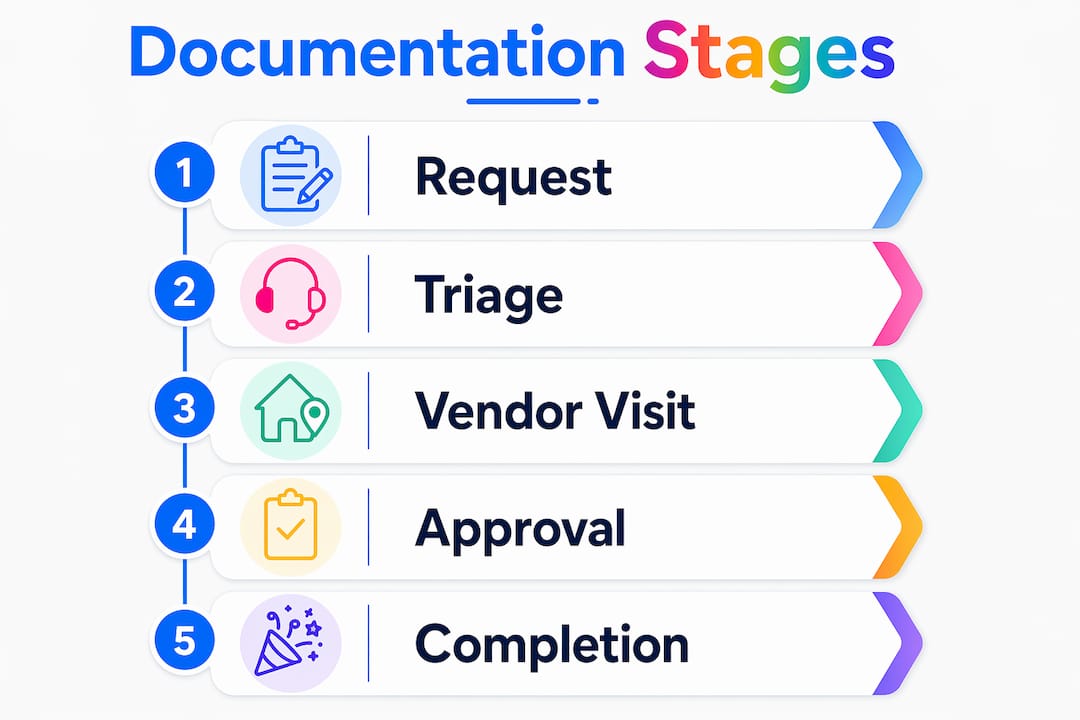
Complete documentation is built on five stages: request, triage, vendor visit, owner approval, and completion. A verified timeline covering all five stages is far more defensible than a receipt alone. Each stage must capture who did what, when, and why.
The core elements every repair record needs include:
Timestamped work orders. Every work order must show the exact date, time, and the name of the person responsible. Undated work orders are one of the most common causes of legal disputes.
Before and after photos with metadata. Photos must be linked to specific repair steps, not just attached loosely to a file. Metadata, including GPS location and timestamp, ties each image to the actual event.
Immutable audit trails. Immutable audit logs and metadata prove that records were not altered after the fact. This is what separates credible documentation from a reconstructed story.
Centralized storage. Records scattered across email threads, paper folders, and spreadsheets create gaps. A centralized system makes every record searchable and deliverable on short notice.
Technician notes and workflow steps. Notes explain the context behind each photo or work order. Combining photos, notes, timestamps, and workflow steps produces a record any third party can understand without additional explanation.
Pro Tip: Set a rule that no repair is considered closed until all five documentation stages are marked complete in your system. A closed work order with missing photos is not a closed work order.
How does thorough documentation reduce legal and financial risks?
Missing or incomplete records create direct financial exposure. Missing inspection photos or undated work orders can cost up to $50,000 in liability per incident. That figure reflects real court settlements and insurance denials, not hypothetical risk.
“Reconstructed documentation created after the fact is frequently treated as suspect or invalid.” — Rental Maintenance Documentation Guide
Contemporaneous documentation, meaning records created at the time of the repair, carries legal weight that reconstructed records do not. A property manager who logs a repair three weeks after the fact, even with good intentions, gives a court or adjuster reason to question the entire record. The timing of documentation is as important as its content.
Systematic property maintenance records also reduce costs over time. Tracking maintenance history systematically reduces operational costs by 18–27% and extends asset life by 3–5 years. That reduction comes from replacing guesswork with data. When you know exactly when a roof was last repaired and what materials were used, you make better decisions about when to repair versus replace.
Insurance claims are another area where documentation pays off directly. Missing documentation is a primary cause of delays and disputes in insurance claims for repairs. Adjusters approve claims faster when the record answers their questions upfront about repair scope, materials used, and methodology. A well-documented claim moves through the process. A poorly documented one stalls.
Manual vs. digital: which documentation approach actually works?
Most property managers still rely on fragmented systems. 73% of US property managers use fragmented record-keeping systems that are prone to data loss and legal exposure. Spreadsheets, email chains, and paper notes each hold pieces of the record, but none of them connect.
Feature | Fragmented/Manual Systems | Digital Maintenance Management Tools |
Timestamps | Manual, often missing | Auto-generated and immutable |
Photo storage | Scattered across devices | Centralized, linked to work orders |
Audit trail | None or incomplete | Full, tamper-evident log |
Accessibility | Requires manual search | Searchable, shareable instantly |
Compliance readiness | Low | High |
Risk of data loss | High | Low |
Digital maintenance management tools, such as platforms that integrate work orders, photo uploads, and audit trails in one place, solve the fragmentation problem directly. Documentation integrated into maintenance apps avoids “documentation theater,” which is the practice of creating paperwork that looks complete but is disconnected from the actual work. When documentation is built into the workflow, it gets done consistently.
Pro Tip: Before selecting a digital tool, test whether it can produce a complete repair history for a single property in under two minutes. If it cannot, the system is not centralized enough to protect you in a dispute.
Best practices for homeowners and property managers
Effective record keeping in home repairs requires structure, not just effort. These practices apply whether you manage one property or twenty.
Assign documentation ownership for every repair. One person must be responsible for completing the record at each stage. Shared responsibility with no named owner means the record gets skipped.
Use standardized forms or software that capture all five timeline stages. A custom spreadsheet that only tracks completion dates misses the triage and approval stages that matter most in disputes.
Take photos at every phase, not just at the end. A before photo, a mid-repair photo, and an after photo tell a complete story. An after photo alone proves only that the work was done, not how or when it started.
Create records at the time of the repair. Contemporaneous, auto-timestamped documentation is the standard for valid evidence. Log the record the same day, not the same week.
Run quarterly audits of your documentation completeness. Pull ten random work orders and check whether all five stages are documented. Gaps found in an audit are far less costly than gaps found in court.
Choose tools built for non-experts. 64% of US properties use incomplete inspection documentation. The most common reason is that the documentation system is too complex for the people using it. A tool that requires minimal training gets used consistently.
Connecting documentation to ethical home renovation practices also builds trust with tenants and contractors. When everyone involved knows the record exists, accountability follows naturally.
What challenges arise in repair documentation and how do you fix them?
The most common documentation failures are predictable and preventable.
Incomplete records. A work order with no photos or a photo file with no linked work order are both incomplete. Neither stands alone as evidence. Fix this by requiring both elements before a work order can be marked closed.
Timing delays. Records created days or weeks after a repair are legally weaker than same-day records. Build documentation into the repair workflow so it happens automatically, not as a follow-up task.
Fragmented storage. When photos live on a contractor’s phone, notes are in an email, and the work order is in a spreadsheet, the record cannot be assembled quickly under pressure. Centralized cloud platforms solve this directly.
Vendor and tenant communication gaps. Contractors who do not know your documentation requirements will not meet them. Include documentation expectations in every service agreement, not just verbal instructions.
Documentation theater. Standard operating procedures become ineffective when documentation is disconnected from the actual work process. A binder full of forms that nobody fills out in real time is not a documentation system. It is a liability.
Automation reduces the burden on individuals. Platforms that auto-timestamp entries, require photo uploads before status changes, and generate audit trails by default remove the human error that causes most documentation failures. The goal is a system where good documentation is the path of least resistance, not an extra step.
Understanding how home repair supports community accountability also reinforces why documentation matters beyond individual properties. Transparent records protect everyone in the chain.
Key Takeaways
Thorough, contemporaneous property repair documentation is the single most effective way to reduce legal exposure, speed up insurance claims, and lower long-term maintenance costs.
Point | Details |
Document all five stages | Record request, triage, vendor visit, approval, and completion for every repair. |
Use immutable timestamps | Auto-timestamped records are legally stronger than manually entered or reconstructed ones. |
Centralize all records | Fragmented storage across email and spreadsheets creates gaps that cost up to $50,000 per incident. |
Photograph every phase | Before, during, and after photos linked to work orders create a complete, defensible record. |
Audit documentation quarterly | Regular audits catch gaps before they become legal or insurance problems. |
Why I stopped treating documentation as an afterthought
I have been in facilities management long enough to watch a single missing photo cost a property owner a five-figure settlement. The contractor did the work correctly. The repair was solid. But there was no before photo, no timestamped work order, and no record of who approved the job. The tenant’s attorney had a field day with that gap.
What I have learned from years of managing repairs across residential and commercial properties is that documentation is not a bureaucratic requirement. It is the proof that your work was done right. When you skip it, you are not saving time. You are borrowing trouble.
The shift I have seen in 2026 is that more homeowners and property managers are treating documentation the same way they treat the repair itself: as a non-negotiable part of the job. Digital tools have made this easier. You can photograph, timestamp, and upload a record from a phone in under two minutes. There is no longer a credible excuse for incomplete records.
My advice is simple. Start with the five-stage timeline on your very next repair, even a small one. A leaky faucet documented properly is practice for the roof replacement that will matter in court. Build the habit before you need it.
— Ricco
Documented repairs, delivered with accountability by Manycolorswi
Manycolorswi brings the same commitment to transparency that this guide describes. Every repair job includes clear records, timestamped photos, and a complete work history you can reference for insurance, resale, or future maintenance decisions.

Manycolorswi serves homeowners and property managers across Milwaukee with flooring, drywall, painting, and lawn care, all backed by a workforce trained to document every step of the process. The team at Many Colors understands that quality work and quality records go together. When you hire a crew that treats documentation as part of the job, you get a repair history that protects your investment long after the work is done.
FAQ
What is the role of documentation in property repairs?
Property repair documentation creates a verifiable record of every repair activity, protecting homeowners and property managers in legal disputes, insurance claims, and compliance reviews. It covers the full timeline from repair request through final completion.
How does incomplete documentation create financial risk?
Missing inspection photos or undated work orders can create up to $50,000 in liability exposure per incident. Incomplete records also delay insurance claim approvals and weaken your position in tenant disputes.
What makes documentation legally valid in a repair dispute?
Contemporaneous documentation, meaning records created at the time of the repair with auto-generated timestamps, is treated as valid evidence. Reconstructed records created after the fact are frequently treated as suspect by courts and insurers.
How often should property managers audit their repair records?
Quarterly audits are the recommended standard. Pulling a sample of ten work orders each quarter and checking for completeness across all five documentation stages catches gaps before they become legal problems.
What is the fastest way to improve repair documentation practices?
Switch from fragmented systems like spreadsheets and email to a centralized digital maintenance management tool that auto-timestamps entries and requires photo uploads before a work order can be closed.
Recommended
Comments