
How to Develop Teamwork Skills on the Job
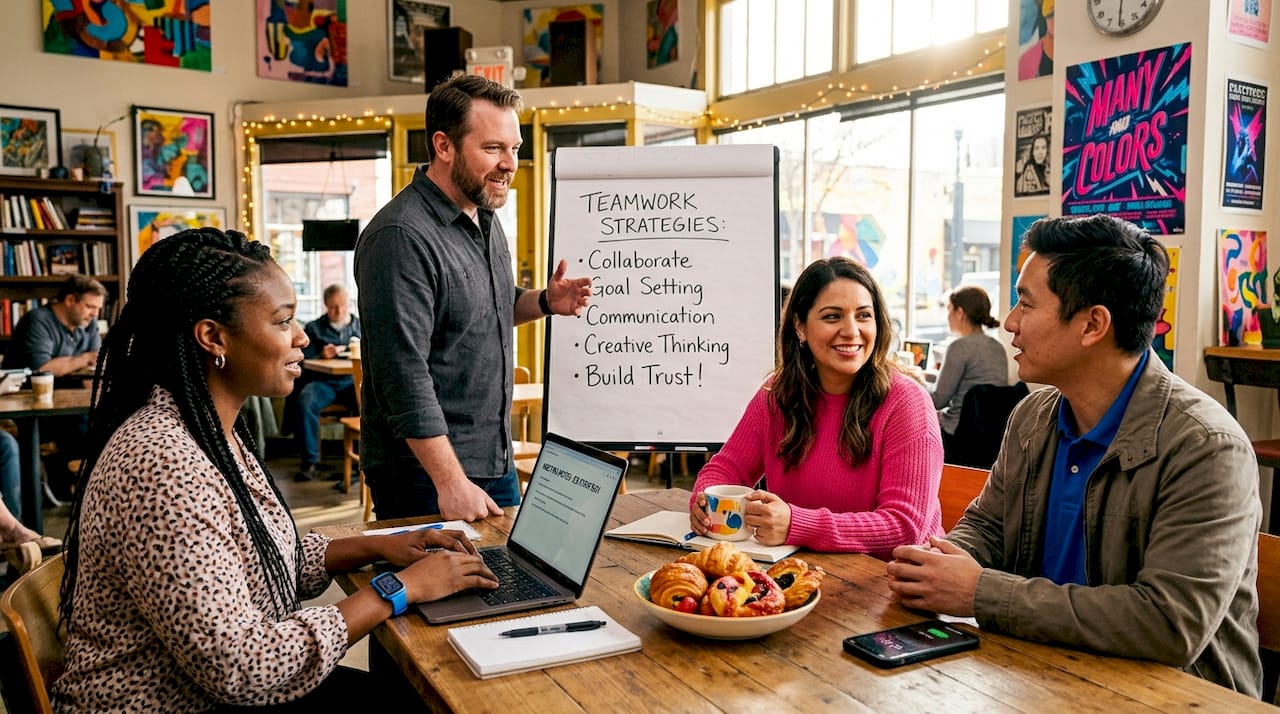
Poor teamwork costs more than most managers want to admit. Missed deadlines, repeated misunderstandings, and friction between colleagues don’t happen because people are incompetent. They happen because no one took time to actively develop teamwork skills on the job. The good news is that collaboration is a learned behavior, not a personality trait. This guide gives you a research-backed, step-by-step path to build real team skills at work, whether you’re an individual contributor trying to show up better for your team or a manager leading team development initiatives that actually stick.
Table of Contents
Key takeaways
Point | Details |
Psychological safety first | Build a climate where team members speak up before focusing on skill drills or productivity goals. |
Role clarity reduces friction | Use RACI or DACI frameworks to eliminate confusion about who owns what before collaboration breaks down. |
One skill at a time | Set SMART goals targeting a single teamwork behavior per cycle to make progress measurable and sustainable. |
Limit retrospective commitments | Cap improvement actions to three per cycle to avoid implementation fatigue and keep trust intact. |
Measure behavioral change | Use pre and post reflections and team health checks to confirm skills are actually improving over time. |
How to develop teamwork skills: the right starting point
Before you can improve team collaboration through exercises or workshops, you need to check a few foundational conditions. Skip this step and you’ll find that even the best training slides off like water on glass.
The first condition is psychological safety. Research with 84 teams and 440 members found strong positive connections between psychological safety and both team cooperation and performance outcomes. In plain terms: people won’t take the interpersonal risks required for real teamwork if they fear embarrassment or retaliation. Safety doesn’t mean everyone agrees or avoids hard conversations. It means the cost of speaking up is low enough that people actually do it.
The second condition is role clarity. One of the most practical tools for this is the RACI model, which labels every task with a single person who is Responsible, one who is Accountable, and others who are Consulted or Informed. The DACI variant adds a Driver role for project momentum. According to IDEO U’s leadership research, combining role clarity with psychological safety empowers teams to act creatively without endless second-guessing or micromanagement.
Here’s a quick reference for the behaviors you’ll want to track as you start this work:
Teamwork behavior | What healthy looks like | Warning sign |
Participation | Everyone contributes in discussions | Same 2-3 voices dominate every meeting |
Communication | Information shared proactively | People find out about changes by accident |
Conflict resolution | Issues addressed directly and early | Tension simmers and surfaces as passive resistance |
Accountability | Owners are named, deadlines are kept | Tasks exist but nobody knows who’s responsible |
The third condition is mindset. A 2026 STEM intervention study found that improving teamwork skills including participation, communication, and conflict resolution also shifted participants’ attitudes toward collaboration positively. The skill and the mindset develop together. You can’t force one without the other.
Practical steps to build collaboration skills at work
Once the foundation is in place, you’re ready for the work of actually developing interpersonal skills at work through structured practice. Here’s a sequence that works for both employees and managers.
Set a SMART goal for one teamwork behavior. Don’t try to fix your listening, your assertiveness, and your conflict style simultaneously. Pick one. A SMART goal here looks like: “I will summarize what the previous speaker said before adding my own point in every team meeting for the next three weeks.” Practical iterative learning with achievable goals makes skill development stick better than broad intentions.
Practice active listening with intention. Most people listen to respond, not to understand. During your next team discussion, try holding your response for three extra seconds after someone finishes speaking. Notice whether your understanding of their point changes. This single habit reduces misinterpretation dramatically and signals respect to teammates.
Ask for structured feedback. After a meeting or project milestone, ask one specific question: “Was there a moment where my communication helped or got in the way?” Vague feedback (“you did great”) teaches nothing. Specific feedback tied to a specific moment changes behavior.
Participate in retrospectives and come prepared. Retrospectives are not complaint sessions. Bring one concrete observation about what went well and one about what you’d adjust. The goal is a behavioral commitment, not a feelings dump.
Name accountability explicitly. When your team wraps up a meeting, make sure every action item has a single named owner and a due date. Designing deliverable-level ownership eliminates the most common execution gap in collaborative work. “We” will do something is not a plan. “Taylor will send the draft by Thursday” is.
Pro Tip: Before each retrospective, write down one specific behavior you want to keep and one you want to change. Share it at the start of the meeting rather than waiting to react. This shifts the dynamic from critique to co-learning and makes the whole team feel safer doing the same.
Working on team communication skills in the context of real deliverables, rather than in isolation, makes the practice transfer faster to actual results.
Frameworks and tools that sustain team growth
Knowing what to do is one thing. Having a system that keeps you doing it is another. Two frameworks stand out in 2026 for how to work effectively in teams over the long term.
PMBOK 8 and the retrospective cycle
The latest edition of the Project Management Body of Knowledge dedicates significant attention to “Lead the Team” as a core project management performance domain. One of its most practical contributions is the recommendation to limit retrospective commitments to three per improvement cycle. This isn’t arbitrary. Overloading teams with improvement actions creates fatigue, and fatigue kills trust in the process. When teams see that commitments are actually completed before new ones are added, they start believing retrospectives matter.
The behavioral loop looks like this: identify one or two behaviors tied to a specific deliverable, run a pre-reflection before the work begins, do the work, then hold a post-reflection to assess what changed. Repeat. It’s simple, but embedding this into recurring team ceremonies is what separates teams that grow from teams that talk about growing.
The IDEO U framework for psychological safety and creativity
IDEO U’s research on creative leadership makes a distinction that most teamwork advice misses. Psychological safety does not mean a free-for-all. In practice, safety requires decision frameworks to prevent endless discussion loops that lead nowhere. When people know who makes the final call (using a DACI or similar model), they feel safer contributing ideas because they’re not worried that raising a concern will derail everything indefinitely.
Common mistakes that undermine teamwork improvement
Watch out for these patterns. They show up in almost every workplace attempting to build better team dynamics:
Neglecting psychological safety while pushing performance. Telling teams to “collaborate more” without creating a safe environment produces surface compliance and hidden resentment.
Shared responsibility with no named owner. Accountability via named owners is what converts coordination into execution. Without it, collaboration produces reports but no results.
Running retrospectives with no follow-through. Leaders who ask for feedback and then ignore it don’t just waste time. They actively damage trust. Leadership modeling intellectual humility and acting on feedback is what makes retrospectives credible.
Pro Tip: Review your last three team retrospectives and count how many action items were actually completed. If the number is below 50%, your team doesn’t have a teamwork problem. It has a follow-through design problem. Fix the system before adding more skill training.
Strategies for team success that combine the PMBOK cycle with IDEO U’s safety-plus-clarity model give teams a structure that holds up under pressure, not just during training sessions. You can see how this plays out in practice through sequencing team improvement within real project work.
Measuring whether teamwork skills are actually improving
Good intentions don’t count as progress. You need signals. Here’s how to verify that your efforts to build teamwork in the workplace are producing real change.
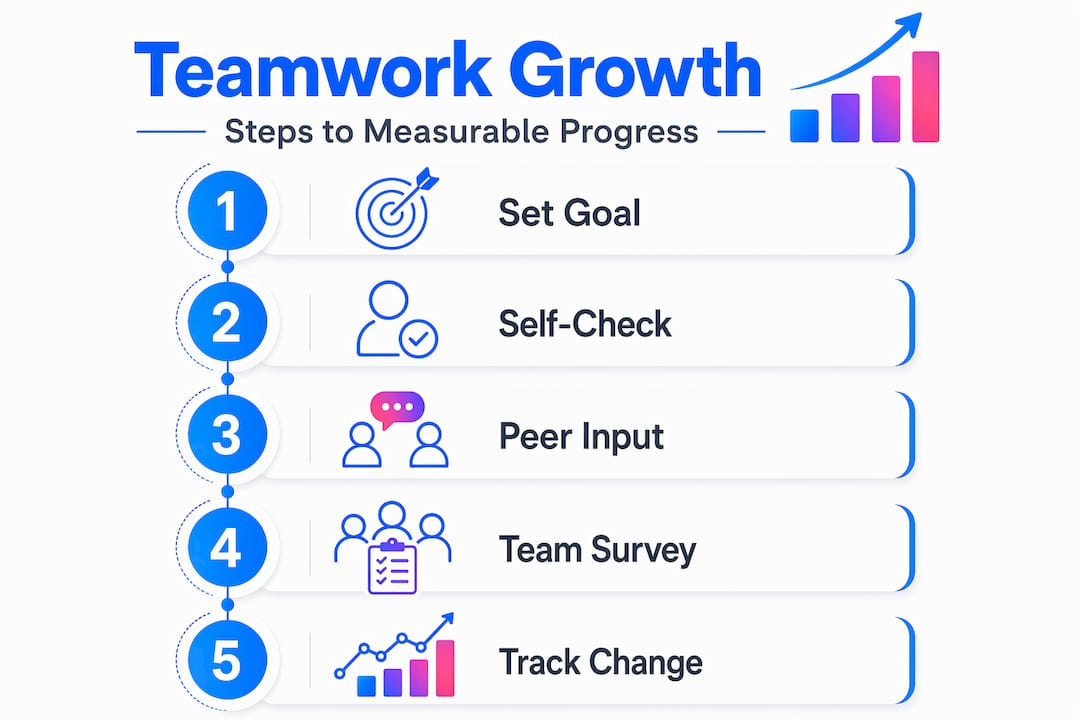
Start with self-assessment after each iteration. Score yourself on the specific behavior you set a SMART goal for. Did you summarize before responding? Did you bring a prepared observation to the retrospective? Honest self-scoring, even without external feedback, builds the habit of reflection.
Add peer input at least once per project cycle. Ask one teammate to observe and comment on one specific behavior. Keep the scope narrow. “Did I let others finish before I responded this week?” is answerable. “How’s my communication?” is not.
Indicator | What to look for |
Meeting participation | More people contributing ideas, fewer silent observers |
Decision speed | Decisions made in meetings rather than revisited repeatedly afterward |
Conflict comfort | Team members addressing disagreements directly rather than avoiding them |
Follow-through rate | Action items from retrospectives completed before the next session |
Psychological safety signals | Team members volunteering problems or mistakes without being asked |
The clearest sign of real improvement is behavioral change that holds under pressure. Anyone can collaborate well when things are easy. When a deadline is missed or a client is unhappy, do team members default to blame or to problem-solving together? That’s your real measure.
Use team health check surveys every four to six weeks. Keep them to five questions or fewer. Frequency matters more than length. Tracking small signals over time gives you data to adjust your goals and strategies, rather than relying on gut feel alone.
My take on building real teamwork where it counts
I’ve spent years leading teams made up of people who weren’t given many second chances elsewhere. What I’ve learned about building teamwork in the workplace didn’t come from a conference room. It came from watching what actually changed behavior on a job site.
The single biggest shift I’ve seen? Starting with psychological safety before anything else. Not as a workshop topic. As a daily practice. When I made it clear that bringing a problem to me early would never result in blame, people started talking. And when people talk, problems get solved before they become disasters.
Here’s the uncomfortable truth I’ve encountered about feedback cultures: most teams say they want honest input, but when they get it, leaders react defensively. That reaction shuts everything down. I learned to model the behavior I wanted. When someone told me my plan had a flaw, I’d thank them publicly and adjust. That one habit changed the room faster than any training program.
I’ve also seen managers pile too many improvement goals onto teams that are already stretched. It doesn’t help. Limiting commitments to three per cycle, as PMBOK 8 recommends, felt counterintuitive at first. But the results were clear: teams completed what they committed to, built confidence, and actually wanted to keep going.
Empathy and structure are not opposites. You need both. The teams I’ve seen thrive are the ones where people feel genuinely respected and where expectations are crystal clear.
— Ricco
How Manycolorswi supports your team’s growth
At Manycolorswi, building real teamwork is not a program we run on the side. It’s embedded in how we work every day. We hire people who’ve been overlooked, train them from the ground up, and watch them grow into contributors their teams rely on. That process has taught us what actually moves the needle when it comes to collaboration, communication, and accountability at work.
If you’re a manager or team member looking for practical, proven ways to strengthen your team’s skills, we’d love to connect. From hands-on training models to the community-first approach we bring to every project, Manycolorswi knows what it takes to build capable, collaborative teams. Explore how our approach to mission-driven team development can give your workplace a real model to follow. Better teamwork starts with a team that believes it’s possible.
FAQ
What are the first steps to develop teamwork skills on the job?
Start by establishing psychological safety and clarifying roles before focusing on skill drills. Research shows that teams perform better when members feel safe contributing and when responsibilities are clearly defined.
How do you measure improvement in workplace collaboration?
Track behavioral indicators like meeting participation rates, decision speed, and retrospective follow-through. Run short team health check surveys every four to six weeks to detect shifts over time.
What is the RACI model and how does it help teams?
RACI assigns every task a single Responsible party, one Accountable owner, and others who are Consulted or Informed. It reduces collaboration confusion by making ownership explicit at the task level.
How many improvement goals should a team work on at once?
PMBOK 8 recommends capping retrospective commitments at three per cycle. Limiting improvement actions prevents implementation fatigue and keeps teams completing what they start rather than accumulating unfinished intentions.
Why do so many teamwork improvement efforts fail?
The most common failure is skipping psychological safety while pushing for performance. When accountability and feedback tools are applied without trust, teams comply on the surface but disengage underneath.
Recommended
Comments