
What Is Ethical Home Spending? A 2026 Guide
Ethical home spending is the practice of investing in home improvements that benefit the environment, support social causes, and create long-term value rather than short-term convenience. Most homeowners think about cost and aesthetics first. Conscious consumers think about where materials come from, who made them, and what happens after the project ends. This guide breaks down the core principles of responsible home purchases, the real numbers behind sustainable upgrades, and how to align your projects with your values without blowing your budget.
What is ethical home spending and why does it matter?
Ethical home spending is defined as the conscious allocation of home improvement funds toward materials, contractors, and projects that meet environmental, social, and longevity standards. The industry term for this practice is “values-based consumption,” and it applies directly to how you plan, source, and execute work on your home. It goes beyond buying a recycled tile or choosing low-VOC paint. It means asking whether your flooring came from a certified forest, whether your contractor pays fair wages, and whether your renovation will reduce your home’s energy load for decades.
The stakes are real. Homes account for a significant share of household carbon output, and the materials industry is one of the largest sources of waste globally. When you spend with intention, you reduce that footprint. You also build a home that performs better, holds its value longer, and reflects what you actually believe.

What are the core principles of ethical spending in home projects?
The first principle is to buy less and repair more. Conscious consumer experts identify this as the single most impactful behavior in ethical home spending. Before you replace a floor, ask whether refinishing it is possible. Before you gut a bathroom, ask what can be reused.
The second principle is verification. Labels like “natural” or “non-toxic” are often unregulated and misleading. Third-party certifications like FSC (Forest Stewardship Council) for wood products and Fair Trade USA for textiles and goods provide reliable proof of social and environmental claims. If a product cannot show you a certification, treat the label as marketing, not fact.
The third principle is building performance. Ethical spending prioritizes insulation, airtightness, and efficient systems over cosmetic upgrades. A well-sealed home uses less energy, costs less to operate, and puts less strain on the grid. That is a measurable social and environmental benefit, not just a personal financial win.
Here is a quick checklist of core criteria to apply before any purchase:
Does this product carry FSC, Fair Trade USA, or another recognized third-party certification?
Can I repair, refinish, or reuse what I already have instead of replacing it?
Does this upgrade improve the building envelope (insulation, windows, air sealing)?
Is the contractor paying fair wages and sourcing responsibly?
Will this material or system last 20 or more years?
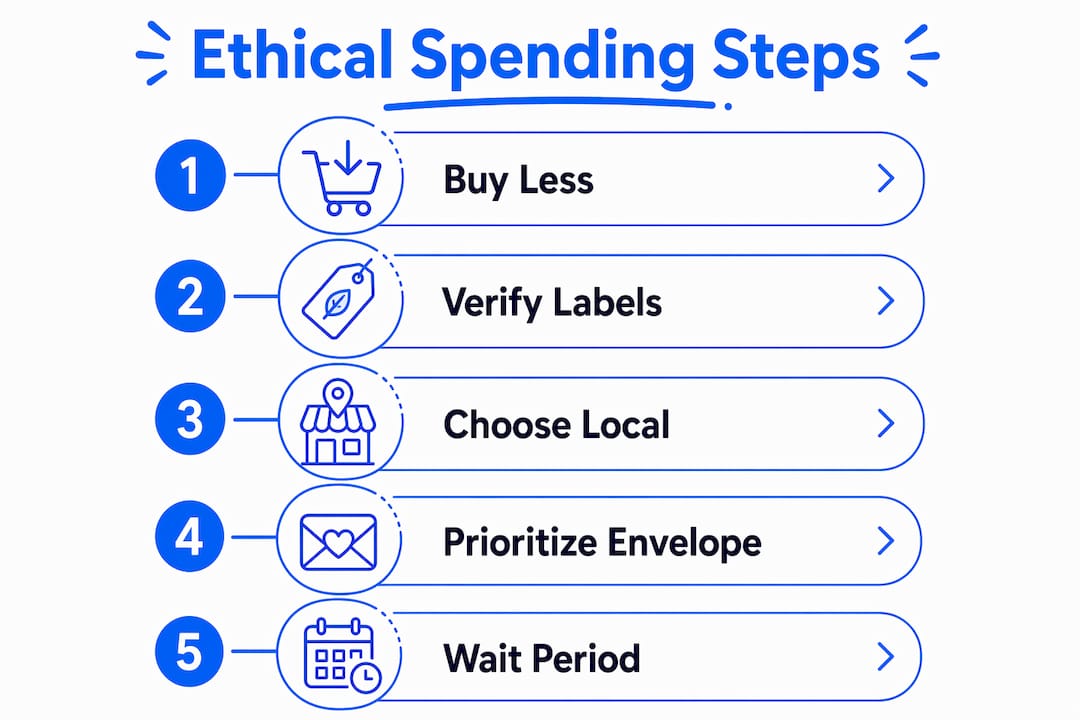
Pro Tip: Apply a 24–48 hour waiting period before any non-essential home purchase. This single habit reduces impulse buying and the waste that comes with it.
How does ethical home spending affect costs and savings?
The upfront cost of ethical upgrades is real. Building or upgrading to high-performance eco-standards adds a “green premium” of 5%–15% over conventional construction. Basic eco upgrades sit near the 5% mark, while full Passive House standards push toward 15%. That number sounds intimidating until you look at what comes back.
Well-insulated, airtight homes cut heating and cooling costs by 50%–70%. That is not a marginal improvement. It is a structural change in how much you spend every month. Upgrading wall and roof insulation alone can reduce household heating loads by 20%–40%, which pays back the investment faster than most homeowners expect.
On the materials side, sourcing reclaimed, salvaged, or surplus materials saves 30%–70% compared to new conventional materials. Reclaimed hardwood floors, salvaged brick, and surplus tile are often higher quality than new equivalents. They carry a story, and they cost less.
The resale picture is also shifting. Sustainable upgrades command a 5%–10% resale premium in the 2026 housing market. Buyers are paying more for homes with lower operating costs. That trend is accelerating as energy prices rise.
Use this table to compare common ethical upgrades by cost impact and return:
Upgrade | Green Premium | Energy/Cost Savings | Resale Impact |
Wall and roof insulation | Low (5%) | 20%–40% heating load reduction | Moderate positive |
Air sealing and weatherization | Very low | Significant utility savings | Positive |
High-efficiency HVAC | Moderate (10%–15%) | 30%–50% HVAC cost reduction | Positive |
Reclaimed/salvaged materials | Negative (saves 30%–70%) | No direct energy savings | Positive, aesthetic value |
Solar panels | High (15%+) | Near-zero electricity costs | Strong positive |
Pro Tip: Prioritize envelope upgrades like insulation and air sealing before buying new equipment. Sealing the building first means your new HVAC system works less and lasts longer.
What practical steps help you budget ethically for home improvements?
Ethical home budgeting starts with intentional allocation. One practical framework adapts the standard 50/30/20 budget rule into a values-based version: 50% for needs, 20% for savings, and 30% designated specifically for values-aligned spending. That 30% covers certified materials, fair-wage contractors, and community-supportive suppliers. It gives your ethics a line item, not just good intentions.
Start every project with the repair-and-reuse audit. Walk through your home and list what can be fixed, refinished, or repurposed before you spend a dollar on new materials. This step alone can cut project costs significantly and reduce waste.
When you do buy new, source strategically. Reclaimed and bulk materials consistently deliver the best combination of ethical credentials and cost savings. Habitat for Humanity ReStores, local salvage yards, and surplus building supply outlets are reliable sources for certified and reclaimed goods.
Sequence your projects by payback period. A payback period calculation divides the upgrade cost by annual utility savings. Projects that pay back in under five years are your highest-priority investments. Insulation and air sealing almost always clear that bar. Solar panels often take longer but carry strong resale value.
Here is a practical budgeting checklist for ethical home projects:
Audit repair and reuse options before purchasing anything new
Allocate a dedicated percentage of your home budget to values-aligned spending
Verify certifications (FSC, Fair Trade USA, ENERGY STAR) before finalizing any material purchase
Calculate payback periods for all major upgrades and prioritize accordingly
Choose contractors with transparent labor practices, fair wages, and community ties
Source reclaimed or surplus materials first, then certified new materials second
Choosing a contractor is also an ethical decision. Companies like Manycolorswi, which trains and employs individuals from marginalized backgrounds, represent social impact home improvement in practice. Your contractor choice is part of your ethical spending footprint.
How does ethical home spending create social and environmental benefits?
The benefits of ethical home spending extend well beyond your property line. When you hire local artisans, choose fair-trade certified goods, and work with contractors who pay living wages, you strengthen the economic fabric of your community. That is not abstract. It means more stable employment, more money circulating locally, and more skilled workers in your neighborhood.
Environmentally, the impact compounds over time. Homes built or renovated with high-performance insulation, reclaimed materials, and efficient systems produce less waste during construction and consume less energy for decades. Every pound of reclaimed wood used is a pound that did not go to a landfill and a pound that did not require new timber harvesting.
Ethical spending also pushes back against greenwashing. When you demand FSC certification instead of accepting a “natural wood” label, you signal to manufacturers that vague claims are not enough. That market pressure, multiplied across thousands of homeowners, changes what gets produced and how.
The contrast with fast consumption is stark. A homeowner who replaces cabinets every ten years for aesthetic reasons generates far more waste and carbon than one who refinishes existing cabinets and invests the savings in insulation. The community impact of home repair over replacement is measurable in both environmental and social terms.
Consider these broader benefits when planning your next project:
Supporting local suppliers and fair-wage contractors keeps money in your community
Choosing durable, certified materials reduces landfill contributions from renovation waste
High-performance homes lower neighborhood energy demand and grid stress
Ethical contractor choices create employment pathways for workers who need them most
Key takeaways
Ethical home spending delivers the strongest results when you combine verified materials, envelope-first upgrades, and socially responsible contractor choices from the start.
Point | Details |
Repair before replacing | Reusing and refinishing existing materials is the most impactful ethical spending decision you can make. |
Verify with certifications | FSC and Fair Trade USA labels confirm ethical claims; “natural” and “non-toxic” labels often do not. |
Envelope upgrades first | Insulation and air sealing cut heating costs by 20%–40% and should precede any equipment purchase. |
Use payback period math | Divide upgrade cost by annual savings; prioritize projects that pay back in under five years. |
Contractor choice matters | Hiring fair-wage, community-rooted contractors is a direct act of ethical home spending. |
What i’ve learned about spending ethically on your home
Most homeowners I work with come in thinking ethical home spending means spending more. That is the wrong frame. The real shift is from “more” to “better.” Better materials. Better sequencing. Better contractors. Better questions asked before any money moves.
The mistake I see most often is skipping the building envelope. Homeowners spend thousands on a new HVAC system in a poorly insulated house and wonder why their bills barely drop. The house is leaking heat through the walls and attic. Fix that first. The equipment upgrade becomes far more effective and far less expensive when the shell is tight.
I have also watched homeowners get burned by greenwashing. They pay a premium for a product labeled “eco-friendly” with no certification to back it up. That money does not go to a better outcome. It goes to better marketing. Always ask for the certification number, not just the label.
The part that surprises most people is the satisfaction. When you hire a crew that includes workers rebuilding their lives, when you source a reclaimed floor with real history, when your energy bill drops 60% after a proper insulation job, the project feels different. You are not just improving a house. You are participating in something larger. That is what ethical home spending actually feels like from the inside.
— Ricco
Start your ethical home improvement journey with Manycolorswi
Knowing the principles is one thing. Finding the right team to execute them is another. Manycolorswi was built specifically for homeowners who want their renovation dollars to do more than fix a floor or paint a wall.

Manycolorswi offers flooring, drywall, painting, and lawn care services with a workforce trained from within Milwaukee’s most underserved communities. Every project you hire us for supports fair wages, workforce development, and community reintegration. You get quality home improvement work, and your spending creates real social impact. Visit Manycolorswi to explore services and see how your next home project can reflect your values from the first nail to the final coat.
FAQ
What is ethical home spending in simple terms?
Ethical home spending means choosing home improvement materials, contractors, and projects that meet environmental, social, and quality standards. It prioritizes repair over replacement, certified materials over vague labels, and fair-wage labor over the cheapest bid.
How much more does ethical home spending cost upfront?
Eco-friendly upgrades typically add a green premium of 5%–15% over conventional costs. Sourcing reclaimed or salvaged materials can offset that premium by saving 30%–70% on material costs.
What certifications should i look for in ethical home materials?
Look for FSC certification on wood products and Fair Trade USA on textiles and goods. These third-party certifications verify environmental and social claims that unregulated labels like “natural” or “non-toxic” cannot.
How do i prioritize ethical home upgrades on a limited budget?
Use the payback period formula: divide the upgrade cost by annual utility savings. Projects paying back in under five years are your best starting point. Insulation and air sealing almost always qualify.
How does choosing a contractor count as ethical home spending?
Hiring contractors who pay fair wages, employ workers from underserved communities, and source responsibly makes your labor spend part of your ethical footprint. The social impact of your contractor choice is as real as the materials you select.
Recommended
Comments